
Education is the basic and fundamental
right of every child in this world, regardless of nationality, race, gender or status.
We at Team 2ndskin believe that every child should be granted equal opportunity
and rights to at least basic education so that they will be able to survive in
this world and have a better and brighter future. This is also the basis to why
we have chosen Dignity for Children Foundation (DIGNITY) as the beneficiary of
our pilot campaign under Project CARES.
DIGNITY provides education to the
underprivileged and urban poor children in an effort to break the poverty cycle
that will keep rotating if not intervention is made. A more in depth
understanding of DIGNITY and their vision and mission can be found at their
official page - http://dignityforchildren.org/home/visionmission
What
is Team 2ndskin doing for Project DIGNITY CARES?
LimEe-Van and Roy
Yeow, 2 athletes who race under the Team 2ndskin umbrella together with
team principal Eugene Teoh will put
their physical and mental capacities to the test at the tail-end of March 2013
in a bid to raise funds for Dignity for Children Foundation.
Ee-Van will fly to Sabah to participate in the Sabah Adventure
Challenge 2013, a 3-day endurance race (from 29th – 31st March) across the
Kinabalu Crocker Range. He will cover 75km on foot over 3 days and will need to
be self-sustaining and to navigate his way through the adventure challenge. The
level of challenge will be extreme as he will have to face Mother Nature in her
own backyard, rough terrains, unpredictable weather and the fear of the unknown
in the remote rainforests of Sabah. Ee-Van is expected to race for up to 8
hours a day while carrying his own supplies and equipment required to work his
way through checkpoints.
On the same weekend, Roy and Eugene will head down south to our
neighbor country Singapore to participate in the Twilight 16 Hours Ultra
Challenge. This event is a 16 hour run from 7pm 30th March right up to 11am 31st
March. Both their mental and physical conditions will be put to the test as
they battle tiredness, fatigue and sleepiness to complete this grueling event.
While most of Malaysians and Singaporeans will be sleeping, these 2 guys will
be pounding the tarmac in a bid to create awareness and hopefully benefit
DIGNITY.
How
can you help?
Team 2ndskin has linked up with People Giving
Foundation (http://www.peoplegiving.org/about-us) to create this campaign
Project DIGNITY CARES which will benefit Dignity for Children Foundation. This
campaign will be hosted on People Giving’s online portal at http://www.peoplegiving.org/campaign-page?campId=32 Note
that all funds and donations raised will be channelled to DIGNITY and that
People Giving and Team 2ndskin do not take any fee from this campaign.
You can make this a success by going to our
Project DIGNITY CARES campaign page http://www.peoplegiving.org/campaign-page?campId=32 and help by donating (any amount will do) to our campaign and benefitting the
underprivileged children with hopes for some level of education. On top of
that, please help us to share our campaign on your own Facebook page, Twitter,
blog or email correspondents so as to create awareness of Project DIGNITY CARES
to a wider audience. Your goodwill and kind gestures will truly be appreciated
by these children; help bridge the disparity in education opportunities and
give hope and a glimmer of light to the future generation.
What
Team 2ndskin Athletes Say
How do you juggle your workload,
family commitments and find the time to train for such an event?
Lim
Ee-Van:
Life-Work Balance. Keep work at working hours and spend
the rest on life. We sleep 8hours (ideally, but we hardly do), work 8hours, and
spend the balance 8 on other priorities such as family and passion we have
(i.e. sports).
On average, we need only 90mins max to train/day and a
proper plan is essential. Discipline ensures that the plan goes through.
Determination to see it executed to plan. 90mins is just 6.25% of our day, we
likely spend more time eating than exercising ;)
Most people find that running for 30 mins is
already very tiring. What inspires you to run non-stop for 16 hours?
Roy Yeow:
Human
physiology is made for endurance running. The thought of our ancestors chasing
down their meals through hours and hours of running has given me the
inspiration to simulate the gruelling task.
Have
a question?
Talk to us at – info@2ndskin.asia
Feel free to ask us anything about the
campaign and we will endeavour to answer all your questions with as much
information as we can. Last but not least, thank you for taking the time to
read through our campaign and help us to share the awareness.
Team 2ndskin is powered by 2ndskin Clothing, SkechersPerformance Malaysia, Garmin Malaysia and Hammer Nutrition Malaysia.
For more information about Team 2ndskin's Project CARES, please go to http://www.team2ndskin.blogspot.com/p/project-cares.html
|

Official Team 2ndSkin Blog | passion + motivation + inspiration
Thursday, 28 February 2013
Project CARES : Dignity For Children Foundation


Wednesday, 27 February 2013
Motivation. Rule Your Mind.
Ask yourself this; have you ever thought
about giving up when your muscles are screaming, your lungs are heavy and your
breathing is labored towards the end of your long run/race? Have you ever been
injured / had to layoff and found it difficult to get back into your stride?
Having trouble waking up in the morning for your training sessions and rather
just sleep in? Ever wanted to run 5 laps but ended up with only 3 cos you just
didn’t feel like continuing?
If you answered yes to one or more (or even
all) of the questions above, read on.
The mind is a very complex subject, and I
do not claim to be an expert motivator, but I have experienced many of such
episodes over the years of running / training and I would like to share some of
the methods to overcome the mental barrier.
I bet many of you have run a long distance
race and mid or 3-quarter way through, your mind tells you that you are
suffering badly, you cannot go on at this pace anymore, you need to stop and
walk, you are on the verge of collapse. It feels like you are at the very edge
of your physical limits already. And then, a miracle happens. 300meters from
the finish line, with supporters and bystanders clapping and cheering, and
photographers snapping away, you manage to pull out a sprint for the finish,
hitting a pace where just moments ago you thought was humanely impossible. How
does that happen?
The mind has a built in “safety first”
mechanism, telling you that you should shutdown before you overload yourself.
Now this is a double –edged sword, there are times when you should heed the
warning signs and engage a safety first decision and not be all gung-ho as
there could be severe repercussions. However, at other times (and most times),
your mind will tell you that this is the limit of your capabilities, that you
are tired, and you should stop. This is when you should start to persevere.
Fight your mind games with positive mental notes of your own. Find ways to
counter those thoughts.
When I hit a rut, mid-run, I try to get my
mind off the run, off the number of kilometers I still have to go. What I do
is, I think about other things. I think about business, about strategy, about
new designs, catchy phrases, about short term plans and what is needed to
execute these plans. Bottomline is, to get your mind off the monotony of the
current run. Other times, if I find that I am not in the mood to work those
grey cells, I pick out runners in front of me who have a pace that’s close to
mine. I try to reel them in, try to close the gap and pass them. What I’m essentially
doing is making short term goals and trying to achieve them. It helps in
breaking up the long run into shorter ones and making it more manageable.
Another way is to count lamp posts or the number of runners wearing yellow
shoes (for example).
One method I use for my long training runs
is to do an out and back run instead of multiple loops. If I plan a 30km run, I
make sure that I run 15kms out before I make a turn and (even if there are
other routes/ways to get home, they are at least 15kms long. With that in
place, I can’t “chicken out” of the run and I’ll have to cover the 30kms even
if it means walking home. I call it forced motivation in that I have no other
choice but to “motivate” myself to finish the run and get home.
I also find that external factors (not
within ourselves) can be a very strong source of motivation for us to achieve
our goals. Some people run for a cause, for someone or something they believe
in. I have a friend who helps out at an orphanage and when the going gets tough
for her on a marathon, she starts counting down the kilometers with names of
the orphans she works with. “Km32, this one is for Jay…. Km33, this one is for
Kim…” It gives her the strength and resolve to finish; thinking of the hardship
the orphans go through is motivation for her.
There are other times when you find
yourself down with an injury or setback with a layoff from your sport. After
recovery / rehab, you find that you do not have the motivation to get back into
stride. You feel listless, you can’t wake up in the mornings, you trudge
through your day, not missing the adrenaline you get from working out. It
becomes a vicious cycle, the longer you stay off your training / racing
routine, the lazier you get. It is true of what they say; a body in motion, tends
to stay in motion; a body at rest, tends to stay at rest. How do you address
this? Keep it in mind that even when you are injured, there are other forms of
cross-training you can do that does not affect your injury. Stay active for as
long as you can and work other muscle groups or incorporate other forms of
activity into your routine. If you are currently on recovery mode, start by
slowly increasing your activity levels. The more frequent you start working out
again, the faster you will be back to your fitness levels pre-injury. How then
do you give yourself the kick to push yourself back into racing mode? Try one
or some of these few options here: Get a training buddy; join a sports group;
socialize more with other members of the sporting community; look at old photos
of yourself in races / events; get a new pair of shoes (for your sport) or a
new piece of gear / equipment; sign up for a race.
Remember one thing. Mental strength is an
important tool that most of us don’t work at hard enough. Winning the battle
with your mind is just as important a victory as the run past the finish line.
Written by : Eugene Teoh, Team 2ndSkin Asia
Friday, 22 February 2013
2 Months To Train For A Marathon
The "running your first marathon" by Roy was a popular post. We received an email from a reader asking for advise on running his first one - within the next two months. While we would not recommend preparing for a marathon in less than 6 months, we sense the urgency and the drive by the reader to attempt his/her first 42km (Marathon). We have replied to the reader last week and thought this could be a good sharing for all of us here.
You Asked:
Is it possible to run a marathon (42km) with two months of training?
The Team says:
You Asked:
Is it possible to run a marathon (42km) with two months of training?
The Team says:
We presume you are going for the Langkawi Marathon?
That would be mid April, which is about two months from now
Based on your information provided about your current running regime and weekly mileage about 30km, we find that it is not very adequate to run a marathon strongly. However, if you are looking at finishing and completing your very first marathon, it should be enough, provided you put in some extra training from now on.
We have made the assumption that your average half-marathon time is between 2:15 - 2:30, which gives you about 6:45min/km pace for 21km. What you may want to look at is to complete the 1st 21km of your marathon in about 2hrs 30mins (if you can do it in a shorter time, the better) and look at the remaining 21km in about 3:30 to 4:00 for an under 6:30 finish.
With an 8 weeks plan, you should be looking at tapering the last 2 weeks before the marathon, therefore you have essentially 6 weeks to kick in your training.
Week 1:
- 8km tempo run
- 1 session hillwork + easy run (Total 5 - 7km) *easy run is at your half marathon pace
- 8km tempo run
- LSD: 15km
- Rest days in between and or active recovery (gym work/swimming/cycling)
Week 2:
- 10km tempo run
- 1 session hillwork + easy run (Total 5 - 7km)
- 8km tempo run
- LSD: 18km
- Rest days in between and or active recovery (gym work/swimming/cycling)
Week 3:
- 8km tempo run
- 1 session hillwork + easy run (Total 7 - 9km)
- 8km tempo run
- LSD: 21km
- Rest days in between and or active recovery (gym work/swimming/cycling)
Week 4:
- 8 - 10km easy run
- 10km tempo run
- LSD: 25km
- Rest days in between and or active recovery (gym work/swimming/cycling)
Week 6:
- 14km easy run
- 10km hillwork + easy run
- LSD: 27km
- Rest days in between and or active recovery (gym work/swimming/cycling)
Week 7:
- 10km easy run
- 8km hillwork + easy run
- 15km easy run
- Rest days in between and or active recovery (gym work/swimming/cycling)
Week 8:
- 8km easy run
- 7km easy run
- Rest days in between and or active recovery (gym work/swimming/cycling)
- No running 2 days before the marathon (Fri / Sat), do lots of stretching and hydrate often
The above is a high-level training guide that may help you in finishing your first marathon. What we normally advise is to enjoy your first marathon, and do not set goals for it. Finishing it and having fun at the same time is the most important. Time goals can always come in future marathons.
If your race is Langkawi, one of our athletes Roy will also be there. Feel free to have a chat with him and get his views or recommendations/advice.
Best of luck!
Wednesday, 20 February 2013
Project CARES Team 2ndSkin Community Program
We in 2ndSkin and Team 2ndSkin have always held the belief that engaging in sports is a community based activity. The categories of sports that Team 2ndskin engages in is no different. Road running, cycling, triathlon, trail running, mountain biking; are all well supported by public and have a good following. Last year’s Penang Bridge International Marathon drew more than 34,000 participants across all categories.
Our vision is to get sports to bridge all barriers. To get sports to transcend all boundaries; let not the size of one’s physique, nor the number in one’s age, nor the colour of one’s skin, nor the status of one’s standing in society or community be a hindrance. Sports is for all walks of life.
One of our teams’ goals is to create awareness for sports to those outside the sports community. To make the circle bigger, so to speak. To let more people know about the benefits and importance of instilling a healthy lifestyle and engaging in physical activities to complement their daily lives. On top of that, we are also in this to keep the newbies motivated, to constantly support those who are new to sports and to keep those who are already in it, committed and passionate.
It is with the above in mind, that we have created Project CARES.
The name Project CARES is an acronym of the names of our pioneer team 2ndskin athletes, Chan/Annie/Roy/Ee-Van/Steven.
Project CARES aims to contribute back to society, be it the sports community or the general public. We intend to “give back” to others via programs, campaigns, activities and other means of support.
How will we do it, you ask? We will in time share with you the list of agenda we have on our plate and hopefully, we will also get your support and backing for the work that we do.
Stay tuned for more from Project CARES.
Wednesday, 13 February 2013
Jun Shen : What It Takes To Finish An Ironman
Hi all, we are back. Hope the Chinese New Year break was good for all of you. Jun Shen wrote an entry on what it takes to finish an Ironman last week in his blog. For the uninitiated, an Ironman-distance race is a triathlon race compromising of a 3.8km swim, followed by a 180km bike and finished off with a 42km run, back to back with 17hours cut off.
What does it takes, really? Rewind back to 2008, a young man aged 18 years old aspired to be an Ironman. How did he manage with so little time juggling between studying for a degree, managing life as a Cadet (Navy) Officer and balancing it all up as a son and brother?
This, is Lieutenant Chan Jun Shen's story. Thanks for sharing Chan.
ps- the photos captions were added by the Editor ;-)
-----
What It Takes To Finish An Ironman
 |
| Get Moving Now! |
I did my very first Ironman at the age of 18 years old 1 month 26 days. I was merely a boy back then, but with an abundance of confidence and big dreams. I only did 1 Long Distance Triathlon, 2 Olympic Distance Triathlons and 2 Sprint Triathlons before putting myself on the starting line of Langkawi International Ironman Triathlon. Judging my accomplished races doesn't fully explain how I really train for this toughest event on earth. My concept is simple, race little but train very hard. I maximize my mileage every single week, and I skipped a lot of races to keep myself focus on Ironman. I ride the Broga 212km loop at least once every 2 months, I run 7km everyday, I did 2km swim 3 times a week. The worst part was, I had no Marathon in hand. How am I gonna finish a 3.8km swim, 180km bike and 42km run? In Malaysia, the one and only Long Distance Triathlon is at Desaru, the others are all Olympic Distance. Olympic Distance is not even 1/3 of Ironman. So, my only option is to focus on ONE discipline at one time. I had never thought of rehearsing a Full Distance Ironman =p
.jpg)

.jpg)
Due to my student's routine, I had to attend classes from morning 8am till 4pm. My cadet's training requires me to fit in at least 8 hours of physical training and military classes every Saturday. Every Friday, I did Tempur Tanpa Senjata (I gotta thank TTS for all the bruises). Every night, I had to attend Roll Call (Head Count). Since the University will never compromise on my schedule as a student-cadet-triathlete, I had so little time but so many things to be accomplished. To catch up with my academics, I had friends to help me. Cadet's training, I had no problem catching up. To become an Ironman, no one can share the training load with me, I need to endure it by myself. So, work smart. Let's solve this puzzle one by one.
 |
| It is all part of the plan. Photo blurred to protect the operatives. |

Swimming
Swimming can be the greatest challenge among the 3 disciplines, but once you mastered it, it'll become your closest friend. Firstly, get yr strokes correct before extending the mileage, ask the experts or get a coach! I had no coach, so I learned from Total Immersion videos. I asked a friend to record myself swimming, then correct it bit by bit. There's no shortcut, you need to put in mileage once yr strokes are good. Swimming is still my weakest discipline compared to cycling and running, so I try to "swim smart".
 |
| ...REAAAaaacchhh and Stretchhhhhh... |

Here are the tips : "Drafting is not allowed in cycling due to the extreme advantage gained by the rider riding in the slipstream (the zone with less wind resistance). But there's no such rule in swimming. Water is more than 100 times denser than air, imagine the effort you can reduce if you're swimming behind someone. Try to pace a swimmer who is slightly faster than you. Always remember one of the 10 Principles of War : "Economy Of Effort" !
Cycling
Many athletes buy bikes without even knowing there's such thing as BIKE FIT, I was one of the fools. Learn from my mistakes. I bought a bike with size 49, then my senior told me that when I ride long distance, I need an extra "horn" called Aero Bar. I finished my first Ironman with a really bad bike fit, I suffered very badly on the run. It was TriStupe who told me that the elbow angle must be 90degree, I was curious after knowing the angle need to be adjusted according to your body. Later I read up more about the knee angle, torso angle, and so on. I finished 1 hour faster for my 2nd Ironman with this new bike fit, without putting on extra mileage. Aero Bar is a MUST for the grueling 180km lonely battle, it greatly improves your aerodynamic. Aerodynamic makes you go faster without putting extra effort, we called it "free speed". Once you feel very comfortable and "aero" on the bike, put in at least 200km a week. I'm a busy man, don't have much time to go for long rides. So I did 40km almost every evening with the average of 32km/h, or 35km/h if my team wants to ride Team Time Trial. Only on the weekends, I'll go 212km Broga.
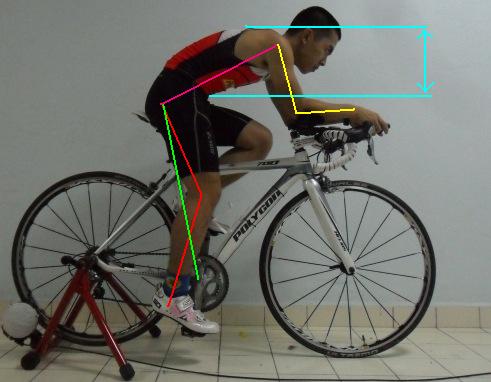 |
| Hamstering On Wheels |
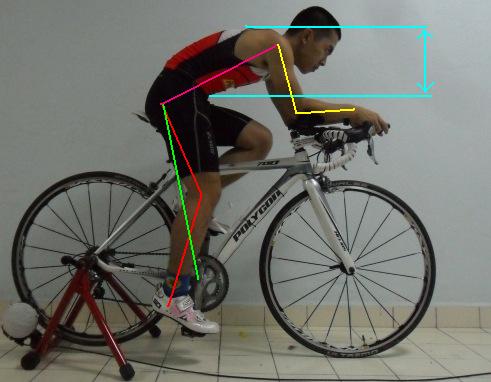
Tips for the Newbies : "Never ever compromise bike comfort for the sake of getting a super aero position. If you have extra cash to spend on a Tri / Time Trial Bike for extra aerodynamic, you can consider Boardman Bikes used by the Ironman Champion Pete Jacob. Refuel and rehydrate accordingly on the bike so that you don't run in empty tank. Electrolytes, energy bars and gels are the "fast foods" that'll keep you going. During training, the calorie burn value should be recorded so that you know how much you'll need to pump in. You'll need to get a good balance between the 3 as each and every one of them serves a different purpose. For example, electrolytes prevent cramping, energy bars supply you with carbohydrates and protein, and so on. Checkout Hammer Nutrition. Lastly, buy a Bento Box to put all your "fast foods" in it."
Running
The last discipline is a 42.195km full marathon. Start your training by correcting the posture first! Running correctly makes you an efficient runner, and also saves you from getting unnecessary injuries. There're lots of running methods and tutorial videos available in the market such as Chi Running and Pose Method, try and decide which one suits you the best. Same like swimming and cycling, once the technique is correct, increase the mileage. I ran 40km a week, raced one half marathon, but never did a full marathon. My first Ironman was my first full marathon =p Don't take unnecessary risks, I was just lucky to finish it. Do a full marathon before deciding to race Ironman. Get a good pair of shoes which suits your running style, be sure that the shoes won't cause you blisters, never ever follow the trend or even your friend! Listen to what your body needs, you might want to consider Skechers, read up about the M-Technology to assist you to land midfoot instead of heel strike.
 |
| I bet the smell from the seafood restaurant was too much, wasn't it? |

Tips to finish the very last discipline : "You'll probably be dead tired during this discipline, try your very best to keep good posture, stay focus on the race and never run with inconsistent pace. Get a GPS watch like the Garmin 910xt to keep yourself (checked) running in constant pace. I didn't feel like eating but I forced myself to eat, because I knew that I need fuel to burn! If the mind stays focused, you'll know what you should do. Also, craving for favorite food is very common, so put it in your Special Need bags."
 |
| One banana. Two Banana. I am Banana. |
I was not in the mood to eat, but I still eat a little every time I stop at the aid station. I was so tanned after more than 10 hours out under the hot sun.
 |
| I'm an ALL WEATHER RUNNER! |

The journey to complete an Ironman has many obstacles to stop you. However, it does help to keep yourself motivated wearing 2ndSkin shirts to remind you of your goals. Let your shirt speaks on your behalf =) Give your very best to complete this toughest event on earth in 17 hours to earn you the title Ironman.
 |
| Awesome |
Written By :
Youngest Langkawi Ironman Finisher Year 2008 & 3 Times Ironman Finisher - Chan Jun Shen

Subscribe to:
Posts (Atom)